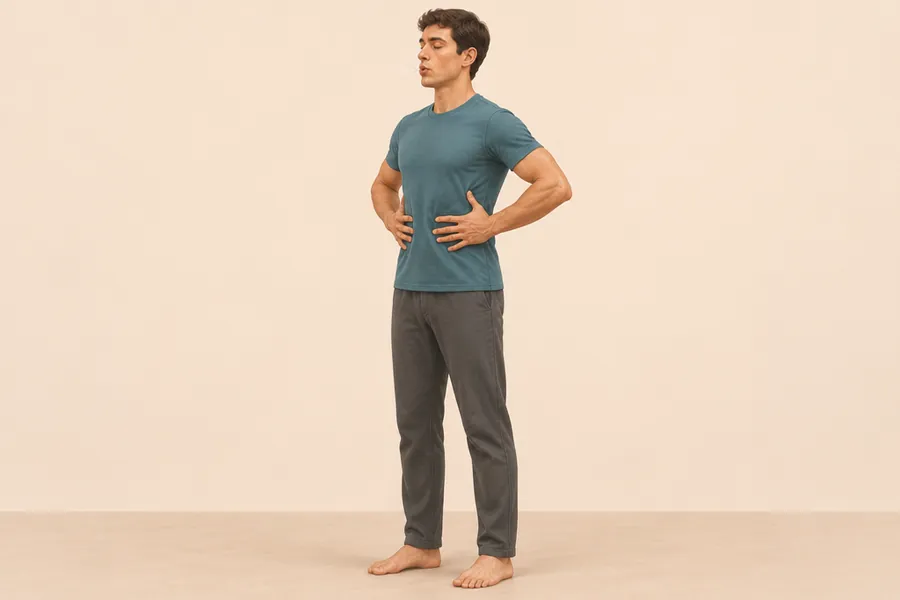
What rib flare is
Rib flare (also called flared ribs or costal flare) means the lower edge of the rib cage, the costal margin, sticks out at the front, just above the belly. It shows most when you stand straight, lie on your back or lift your arms.
Pectus surgeons see it as part of the pectus excavatum shape, not as a separate disease: the cartilages that join the ribs to the sternum grow in an unusual way, the center sinks and the lower edges tip forward. One surgical group writes that it comes with pectus excavatum almost always; there is, however, no reliable figure on how often it happens.
The same authors note that it has no effect on how the heart and lungs work. It is mainly a matter of appearance, and that can matter a lot: many people find it harder to hide than the dent.
In children
In younger children with pectus excavatum, flared lower ribs can make them look as if they have a little potbelly. A potbelly is common in toddlers and usually goes by school age. See a doctor if the belly is hard, tender or swollen, or if the change appeared suddenly.
Rib cage changes can also come from other causes, such as scoliosis, where the flare is often on one side only, or rarely rickets. That’s why a flare on one side, or one that is getting worse, deserves a check.
What causes it
The evidence points to the cartilage of the chest wall, the same as in pectus. The idea that rib flare comes from poor posture, weak abdominal muscles or a faulty breathing pattern is common in physiotherapy and online, but it rests on clinical experience and case reports, not on studies that measured it.
Can exercise fix rib flare?
Honestly: there is no study showing that exercise brings flared ribs down. Nobody has tested it. In pectus excavatum, two small trials added physiotherapy or Schroth exercises to the vacuum bell: posture and quality of life improved, but in the Schroth trial the deformity itself did not improve more than without the exercises.
What exercise can reasonably do is change how you hold your trunk. Standing with the ribs arched forward makes the flare more visible; learning to keep the rib cage stacked over the pelvis, breathe out fully and use your deep abdominal muscles can make it less noticeable in daily life. It won’t reshape the cartilage. Surgeons who developed the Nuss procedure still recommend deep breathing and a posture program as conservative care.
Exercises often used by physiotherapists, if you want to try:
- Full exhale breathing: lying on your back with knees bent, breathe in through the nose, then breathe out slowly and completely, feeling the lower ribs move down and in. 5–8 slow breaths.
- 90/90 breathing: on your back with feet on a wall or a chair, hips and knees at right angles, a small pelvic tilt so the lower back touches the floor. Same long exhale.
- Dead bug: on your back, arms up, knees over hips; slowly lower the opposite arm and leg while keeping the lower back and ribs down.
- Side plank: on your forearm, body straight, 15–30 seconds per side, without letting the ribs flare.
- Posture during the day: ribs over the pelvis, not pushed forward; it helps to check yourself sideways in a mirror.
Stop if they cause pain. To work on the whole chest, the pectus exercise program covers mobility, strength and posture, and the gym guide explains how to train the core and the chest together.
Rib flare and surgery
The Nuss procedure lifts the sternum but doesn’t always correct the flare: it can persist and occasionally gets worse. In a study of 1,571 patients, the flare improved after Nuss in children aged 11 or younger, but not in those aged 12 or older.
Surgeons have several ways to treat it at the same time: removing part of the flared cartilage, pulling the flare towards the bar with strong sutures (the so-called flare-buster, used in more than 400 patients in one center) or crossing two bars. In a 2026 comparison the flare-buster corrected the flare better than the bar alone without extra complications. The UK guideline advises discussing the flare before surgery, because some residual flare is common. If you are heading for the Nuss procedure, ask how your center deals with it.
Braces
No study has tested a brace for rib flare. Compression braces work for pectus carinatum, where the chest sticks out at the center, which is a different situation.
When to see a doctor
- The flare is on one side only, or it is getting worse.
- The chest is also sunken, or the spine looks curved.
- There is pain, or breathlessness on exertion.
- In a child: a hard or swollen belly, bowed legs or poor growth.