Who treats pectus
Children and teenagers are usually seen by pediatric surgeons, adults by thoracic surgeons; some plastic surgeons treat what remains after other treatments. Many hospitals see a few patients a year, a smaller number run a dedicated clinic. That difference matters: when one US children’s hospital opened a pectus center, the share of children with a pigeon chest or a mixed shape who were braced rose from 19% to 63%, and those operated on fell from 15% to 1%. Families traveled up to 1,249 miles for a single visit.
Why experience matters
For the Nuss procedure, the most studied operation, several large studies link experience to fewer complications:
- in 7,183 children in US children’s hospitals, hospitals doing more than 26 repairs a year had less than half the odds of a complication (odds ratio 0.41) compared with those doing 10 or fewer; surgeons doing more than 10 a year had lower odds than those doing one or none (0.55);
- in 9,414 US patients, centers doing at least 20 a year had fewer collapsed lungs (15% versus 23%) and fewer readmissions (4.7% versus 6.8%);
- a review of 49 centers and 13,352 patients found serious complications in 7.7% overall, with the lowest rates at about 73 operations a year. Very few centers in the world reach that number.
No study has set a minimum number for each surgeon. In a Dutch center, surgeons supervised for their first 10 operations showed no typical learning curve afterwards, and the authors recommend at least one operation every 35 days. Life-threatening complications are rare, under 0.1% of an estimated 50,000 operations, but many happened during the learning phase or in patients who had already had chest surgery.
Practice varies between centers
- In a consensus exercise among members of the Chest Wall International Group, experts agreed on only 18 of 62 statements (29%).
- In a survey of 100 surgeons, 79% use a Haller index above 3.25 to decide on surgery, 78% psychological distress and only 46% symptoms. 87% remove the bar after 2–3 years.
- Pain control differs by region: 94% of North American surgeons prefer cryoablation (freezing the rib nerves), elsewhere there is no common choice. In US children’s hospitals its use rose from 33% to 61% between 2016 and 2023.
- For pigeon chest, 93% of centers that answered a survey brace first, but they use different braces.
Two specialists can give different advice and both be reasonable. That is why the reasons behind a proposal matter as much as the proposal itself.
What a good assessment includes
- Questions about symptoms, sport and how the shape affects you, an examination, photos and measurements.
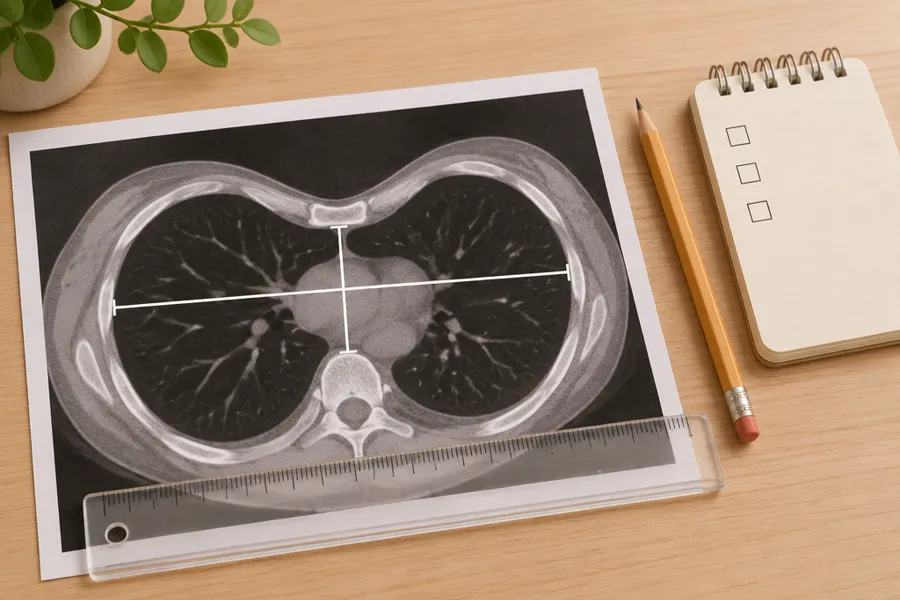
- CT or MRI when treatment is being considered, to measure the Haller and correction index; mild, moderate or severe explains how to read them.
- Heart ultrasound, ECG and lung function tests when there are symptoms. In England, patients with pectus excavatum and breathlessness have lung function tests, a heart ultrasound, a CT and an exercise test before a national team reviews them.
- Checks for related conditions when there are signs of them.
Ask what each test is for. In two US hospitals, 72% of lung function tests and 85% of heart ultrasounds done before surgery were normal, and some were ordered mainly for insurers.
Questions to ask
- How many pectus patients do you treat each year, and how many operations does this surgeon do?
- What are your complication, bar displacement and readmission rates?
- Do you offer the vacuum bell or the brace, or only surgery?
- Which tests do I need, and why?
- How will pain be managed? Is cryoablation available, and is it covered?
- When and where will the bar be removed?
- For adults: how many adults do you operate on, and what are the risks at my age?
- Who can I call after discharge if something is wrong? Is there a psychologist or physiotherapist on the team?
Adults
Complications rise with age. In a US national sample, any complication after the Nuss procedure was recorded in 31% of patients aged 12–17, 45% at 18–29 and 62% over 30, and higher-volume centers operated on older patients. If you are an adult, look for a team that treats adults regularly; the Nuss guide has more on surgery after growth.
Information online and second opinions
Online information is uneven. In a study of 88 websites on the Nuss procedure, quality was low to moderate, hospital sites scored lower than others, and only 9% mentioned the risk of death. In an international survey of 331 people living with untreated pectus excavatum, only 8% were very satisfied with their last medical visit, and most had met health workers who knew little about the condition.
- A second opinion before an operation is normal, and a good center won’t take it badly. Bring your scans, the report and photos.
- The Chest Wall International Group is the largest medical association for chest wall shapes. Membership shows an interest in the field, not a certification: there is no official list of certified pectus centers.
- Where insurance must approve treatment, ask the center to help with the paperwork: in two US hospitals, approval was refused for 5–11% of patients.