When surgery is considered
- the chest is rigid: the sternum doesn’t move back under pressure;
- bracing hasn’t worked or couldn’t be continued;
- the shape is complex: mixed forms (one side protruding, the other sunken), marked asymmetry, or the rare upper (chondromanubrial) form;
- the patient is older: in a Chinese series of 767 patients, the authors suggest surgery may be preferred after 15.
Many centers follow a staged approach: brace first, surgery only for those who need it. The brace guide explains how to tell whether a chest is flexible.
The modified Ravitch operation (open)
Through an incision across the lower chest, the surgeon removes the deformed cartilages while leaving their lining, from which new cartilage grows, and reshapes the sternum with a cut that lets it sit flatter. Some techniques add a temporary support.
- Results: 97% very good or excellent in a series of 260 patients; 92% success in a Dutch series of 105.
- Complications: in the Dutch series, 32% of patients had one.
- Recurrence: none in 61 open operations in a 10-year US series.
- Pain: in a Danish prospective study of 28 patients, 10 still had mild pain at 6 weeks and 4 at 6 months; some had altered skin sensation around the scar. Quality of life improved.
The Abramson operation (minimally invasive)
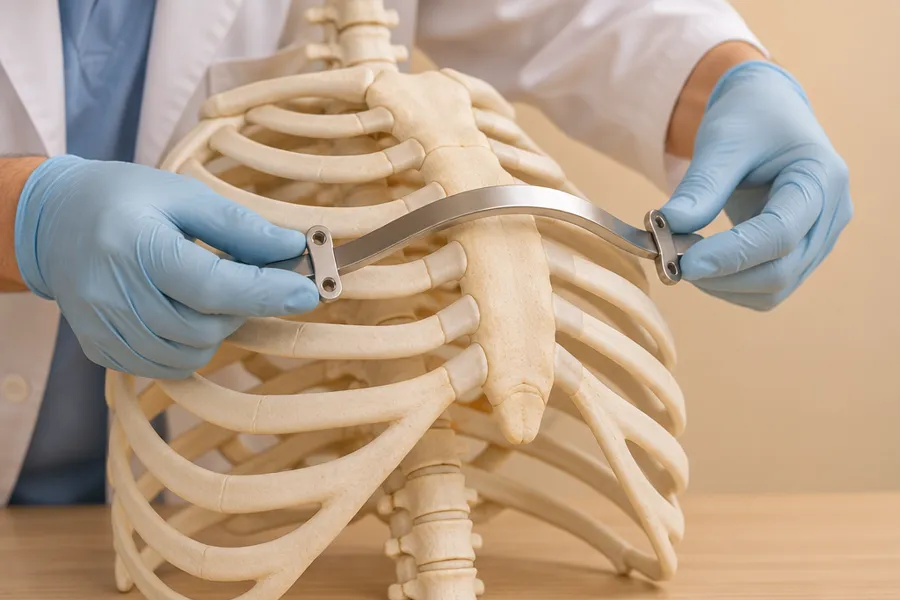
Through small incisions on the sides of the chest, a curved metal bar is passed over the sternum, under the skin and muscles but outside the rib cage, and fixed to plates attached to the ribs on both sides. The bar presses the sternum down, a bit like an internal brace, and is removed after about 2–3 years.
- First series (2009): 40 patients aged 10–21. Hospital stay 3.8 days, back to routine activities after 14 days, bar removed after 2 years or more. Complications included skin adherence over the bar (8), fluid collections (6), broken wires (3), and one each of collapsed lung, persistent pain and infection; none in the last 16 patients.
- Larger series: in 172 patients (average age 17), stay 3.7 days, back to routine activities in 10–14 days, 94% excellent results. In 86 patients over 10 years, 94% had no early complications.
- Review of 396 patients: 91% satisfied after bar removal, 3% recurrence, complications in about a quarter.
Ravitch or Abramson?
There is no randomized trial or meta-analysis comparing them, and small studies disagree. In a 10-year US series, the 23 Abramson patients had more recurrences (13%), revisions (48%) and infections than the 61 open ones. In a 2026 study of 118 patients, satisfaction was highest after Abramson and complications were most frequent after Ravitch (25%), but the questionnaire wasn’t validated. In practice the choice depends on the shape of the chest and on the surgeon’s experience. For mixed shapes, some centers use a combined “sandwich” technique.
Recovery
- Hospital: usually 3–4 days.
- Routine activities: about two weeks after Abramson in the larger series.
- Sport: your surgeon will tell you which activities to avoid while the chest heals and while the bar is in place.
- Scars: one across the lower chest after Ravitch, small ones on the sides after Abramson.
Surgery in adults
Evidence is thin. In a Korean series of 16 patients unsuited to bracing (average age 24, up to 57), the Abramson technique gave excellent results in 38% and good in 56%, with one complication. In an older US series of 116 adults (mostly with excavatum, 12 with carinatum, aged 19–53), 109 of 113 had very good or excellent results after open repair. A stiffer adult chest often makes surgery the main option when the shape bothers you.
Surgery for pectus carinatum is mostly about appearance and comfort. Take time to talk through results, risks and scars with a team that treats chest wall deformities, and ask how many of these operations they do each year.